


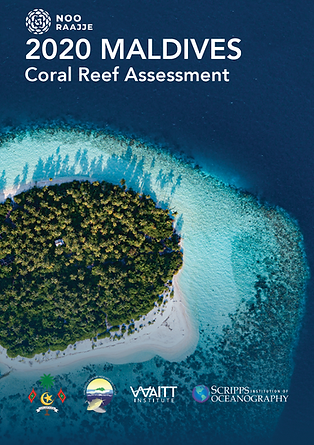
Maldives Coral Reef Assessment
The 2020 and 2021 Maldives Coral Reef Assessments created the first archipelago-wide study of the nation’s ocean, representing the most comprehensive and geographically extensive survey of Maldivian reefs to date.
Building upon the extensive research from the Government and the Maldives Marine Research Institute, these expeditions surveyed 177 sites across 20 atolls. Results from these assessments will be used to inform future marine management efforts in the Maldives.
Led by the Maldives Marine Research Institute, Waitt Institute, and Scripps Institution of Oceanography, these assessments were conducted in partnership with the Maldives Environmental Protection Agency, University of Western Australia, and the Small Island Research Group.

ABOUT
THE EXPEDITION
WHERE DID THE EXPEDITION GO?
The 2020 Maldives Coral Reef Assessment surveyed the coral reefs and fish populations across the northern and central atolls of the Maldives.
The 2021 Maldives Coral Reef Assessment Report surveyed sites in North and South Male and the Southern Atolls.

SURVEY METHODS
The research team surveyed 177 sites spanning 20 atolls across two expeditions.
Survey sites were strategically selected across inhabited, uninhabited, and resort islands to examine how different levels of human activity impact reef health.
To gain a detailed understanding of coral reef health, scientists collected data across six key areas:

Coral reef fishes

Coral recruitment

Reef-building corals

Macroinvertebrates

Benthic community structure

Water quality
KEY STATISTICS
177
survey sites across 20 atolls
442
species of fish recorded
KEY FINDINGS
Comparisons with past studies indicate that Maldivian reefs may be following a recovery trajectory similar to the post-1998 bleaching event, offering encouraging signs for long-term reef resilience.
-
Following the 2016 bleaching event, leeward fore reefs show high turf algae cover, moderate coral and crustose coralline algae (CCA) cover, and very low macroalgae cover.
-
Coral communities were dominated by stress-tolerant Porites corals and showed strong recruitment of new corals.
-
Fish populations were dominated by high abundances of smaller planktivores and moderate abundances of large herbivores.
-
Top predators and sharks were scarce on both reefs and pelagic waters.
These findings can help us understand how Maldivian reefs respond to stress and inform efforts to enhance reef resilience in the face of future climate impacts.



EXPEDITION
PARTNERS
The expeditions were conducted by the Maldives Marine Research Institute, Waitt Institute and Scripps Institution of Oceanography, in partnership with Maldives Environmental Protection Agency, University of Western Australia and the Small Island Research Group.




Small Island Research Group
EXPEDITION
FILMS
MALDIVES EXPEDITION FILM
WOMEN IN SCIENCE FILM
CORAL REEF FILM